 In class we are reading the play in class. Each day we will be writing a short response to the material we have covered. These are graded and will be returned the following day. If you are absent, please make arrangements to complete the writing.
Wednesday, March 3, 2010
Wednesday March 3
Antigone having been caught burying her brother Polyneices In class we are reading the play in class. Each day we will be writing a short response to the material we have covered. These are graded and will be returned the following day. If you are absent, please make arrangements to complete the writing.
In class we are reading the play in class. Each day we will be writing a short response to the material we have covered. These are graded and will be returned the following day. If you are absent, please make arrangements to complete the writing.

Monday, March 1, 2010
March 2, 2010
 Antigone - The play's tragic heroine.
Ismene - Ismene is the good girl of the family. She is reasonable and understands her place, bowing to Creon's edict and attempting to dissuade Antigone from her act of rebellion. As in Sophocles' play, she is Antigone's foil. Ultimately she will recant and beg Antigone to allow her to join her in death. Though Antigone refuses, Ismene's conversion indicates how her resistance is contagious.
<>Haemon - Antigone's young fiancé and son to Creon. Haemon appears twice in the play. In the first, he is rejected by Antigone; in the second, he begs his father for Antigone's life. Creon's refusal ruins his exalted view of his father. He too refuses the happiness that Creon offers him and follows Antigone to a tragic demise.
Nurse - A traditional figure in Greek drama, the Nurse is an addition to the Antigone legend. She introduces an everyday, maternal element into the play that heightens the strangeness of the tragic world. Fussy, affectionate, and reassuring, she suffers no drama or tragedy but exists in the day-to-day tasks of caring for the two sisters. Her comforting presence returns Antigone to her girlhood. In her arms, Antigone superstitiously invests the Nurse with the power to ward off evil and keep her safe.
Chorus - The Chorus frames the play with a prologue and epilogue, introducing the action and characters under the sign of fatality. In presenting the tragedy, the Chorus instructs the audience on proper spectatorship, reappearing at the tragedy's pivotal moments to comment on the action or the nature of tragedy itself. Along with playing narrator, the Chorus also attempts to intercede throughout the play, whether on the behalf of the Theban people or the horrified spectators.
Eurydice - Creon's kind, knitting wife whose only function, as the Chorus declares, is to knit in her room until it is her time to die.
Below is this week's vocabulary. You will have a quiz on Friday. It will consist of putting in the correct word based upon context.
Creon - Antigone's uncle. Creon is powerfully built, but a weary and wrinkled man suffering the burdens of rule. He tells Antigone, his only interest is in political and social order. Creon is bound to ideas of good sense, simplicity, and the banal happiness of everyday life.
Vocabulary 1 for Antigone...QUIZ FRIDAY
1. piety - (noun) religious devotion; reverence to god
2. ingenuity -(noun)- the quality of being clever or inventive
3. to edify- (verb) to instruct or benefit morally
4. to bequeath (verb) to hand down or pass on
5. woe - (noun)- grievous distress or trouble
6. ignoble- (adjective)-of low character or rank
7. haughty-(adjective)- disdainfully proud, snobbish
8. tempestuous - (adjective)- violent, stormy
9. to lament -(verb)-to feel sorrow or regret
10. to beguile-(verb)- to influence by trickery or flattery
11 reverence -(noun)- a feeling or attitude of deep respect
12. portent -(noun)- an indication or an omen that something significant is about to happen.
Monday, February 22, 2010
Tuesday February 23, 2010
Please review your vocabulary. The quiz Friday will be a matching list.
In class for Tuesday and Wednesday. Using your book, please respond to the content questions.
In class for Tuesday and Wednesday. Using your book, please respond to the content questions.
Sunday, February 14, 2010
Monday February 22, 2010
Note the following background information for your reading of The Devil's Arithmetic by Jane Yolen. This is the break assignment. Please contact me with any questions.
I apologize that the images and descriptions are not coordinated, but you should easily be able to put them together.
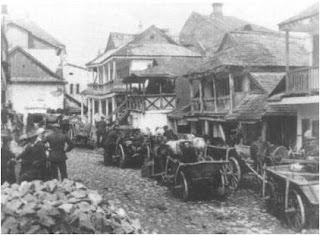
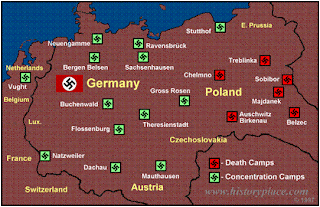
map of concentration camps; please note location of Auschwitz, where the characters in the book have been sent.
Passover: The eight-day festival of Passover is celebrated in the early spring, from the 15th through the 22nd of the Hebrew month of Nissan. It commemorates the emancipation of the Israelites from slavery in ancient Egypt. And, by following the rituals of Passover, the Jewish people have the ability to relive and experience the true freedom that their ancestors gained.
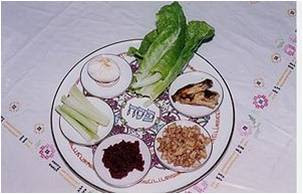
Seder meal / Passover supper: note the following. Remember the novel is framed around the celebration, the interior being Hannah / Chaya's time travel to the schtetl in Poland and her being taken to Auschwitz witht the others. The Seder is an intergenerational family ritual prescribed according to Jewish law and based on the interpretation of the Biblical verse commanding Jews to retell the story of the Exodus from Egypt.
The rituals and symbolic foods
associated with the Seder evoke the twin themes of the evening:
slavery and freedom
The six symbolic items on the Seder Plate are:
1. Maror and 2. Cnazeret : Two types of bitter herbs, symbolizing the bitterness and harshness of the slavery which the Jews endured in Ancient Egypt.
3. Charoset; A sweet, brown, pebbly mixture, representing the mortar used by the Jewish slaves to build the storehouses of Egypt.
4. Karpas; A vegetable other than bitter herbs, usually parsley but sometimes something such as celery or cooked potato.
5. Z’roa; A roasted shankbone, symbolizing sacrifice.
6. Beitzah; A roasted egg.
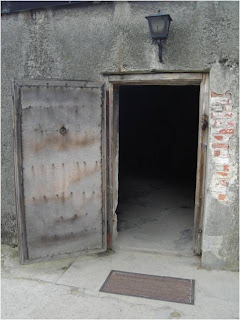
entrance to the gas chamber: this is the last image that Hannah / Chaya sees. Why is she able to cheer up her two companions, knowing that only darkness awaits?
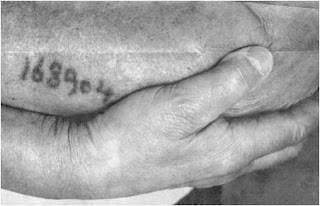
camp identification tattoo- note how Hannah's grandfather reacts when she inks one on herself; how does her attitude eventually change?
The characters in the novel speak Yiddish. Note the following and the words that commonly show up in English that come from this language.
schtetl- a small village in Eastern Europe
bagel - ring shaped bread product
blinz - a thin pancake often filled with fruit or cheese
kvetch- to complain
maven- an expert
putz- a foolish person
schlep- to walk heavily, to trudge
tchochke - little knickknaks
chutzpah - the quality of stepping over the bounds of good behavior
gelt- money
meshuga- crazy
nosh- snacks
schnoz - nose
tush- buttocks
glitch- a problem
klutz - clumsy
kosher- proper or correct
mench - literally a man, but someone who displays upstanding qualities
schmooze- to converse casually so as to take advantage of a social connection
zaftig- full figured
I apologize that the images and descriptions are not coordinated, but you should easily be able to put them together.


map of concentration camps; please note location of Auschwitz, where the characters in the book have been sent.
Passover: The eight-day festival of Passover is celebrated in the early spring, from the 15th through the 22nd of the Hebrew month of Nissan. It commemorates the emancipation of the Israelites from slavery in ancient Egypt. And, by following the rituals of Passover, the Jewish people have the ability to relive and experience the true freedom that their ancestors gained.
Seder meal / Passover supper: note the following. Remember the novel is framed around the celebration, the interior being Hannah / Chaya's time travel to the schtetl in Poland and her being taken to Auschwitz witht the others. The Seder is an intergenerational family ritual prescribed according to Jewish law and based on the interpretation of the Biblical verse commanding Jews to retell the story of the Exodus from Egypt.
The rituals and symbolic foods
associated with the Seder evoke the twin themes of the evening:
slavery and freedom
The six symbolic items on the Seder Plate are:
1. Maror and 2. Cnazeret : Two types of bitter herbs, symbolizing the bitterness and harshness of the slavery which the Jews endured in Ancient Egypt.
3. Charoset; A sweet, brown, pebbly mixture, representing the mortar used by the Jewish slaves to build the storehouses of Egypt.
4. Karpas; A vegetable other than bitter herbs, usually parsley but sometimes something such as celery or cooked potato.
5. Z’roa; A roasted shankbone, symbolizing sacrifice.
6. Beitzah; A roasted egg.
entrance to the gas chamber: this is the last image that Hannah / Chaya sees. Why is she able to cheer up her two companions, knowing that only darkness awaits?
camp identification tattoo- note how Hannah's grandfather reacts when she inks one on herself; how does her attitude eventually change?
The characters in the novel speak Yiddish. Note the following and the words that commonly show up in English that come from this language.
schtetl- a small village in Eastern Europe
bagel - ring shaped bread product
blinz - a thin pancake often filled with fruit or cheese
kvetch- to complain
maven- an expert
putz- a foolish person
schlep- to walk heavily, to trudge
tchochke - little knickknaks
chutzpah - the quality of stepping over the bounds of good behavior
gelt- money
meshuga- crazy
nosh- snacks
schnoz - nose
tush- buttocks
glitch- a problem
klutz - clumsy
kosher- proper or correct
mench - literally a man, but someone who displays upstanding qualities
schmooze- to converse casually so as to take advantage of a social connection
zaftig- full figured
Tuesday, February 9, 2010


Homework due Wednesday: if you did not finish writing out the similes for the poem Willow and Ginko, please finish. This is counting as a test grade. Make sure that after you write the simile, you explain in your own words, its meaning.
In class: we are collecting the novel The Devil's Arithmetic by Jane Yolen from the library.
The book is to be read by the Monday after the break.
Tuesday February 9, 2010
Homework due today: one pun!
Vocabulary quiz on Thursday, with the exception of any student leaving for break early. Your quiz is Wednesday.
In class work: applying poetic language to a poem.
Vocabulary quiz on Thursday, with the exception of any student leaving for break early. Your quiz is Wednesday.
In class work: applying poetic language to a poem.
Friday, February 5, 2010
Monday February 8, 2010

This week's vocabulary based upon The Highwayman by Alfred Noyes
QUIZ THURSDAY FEBRUARY 11
1.galleon- noun- A large three-masted sailing ship with a square rig and usually two or more decks, used from the 15th to the 17th century especially by Spain as a merchant ship or warship.
2. claret-noun and adjective- first: a dark red wine from Bordeaux, France; Second: in the poem it refers to the dark red color of his coat
3. to plait- verb- to braid, especially of hair
4. ostler- noun-one who takes care of horses, especially at an inn
5. stirrups- noun- A flat-based loop or ring hung from either side of a horse's saddle to support the rider's foot in mounting and riding
6. casement- noun- A window sash that opens outward by means of hinges.
7. tawny- adjective- A light brown to brownish orange.
8. cascade- noun- A waterfall or a series of small waterfalls over steep rocks.
9. to snigger- verb- a stifled laugh or giggle
10. to writhe- verb- To twist, as in pain, struggle, or embarrassment.
11. rapier- noun- A light, sharp-pointed sword lacking a cutting edge and used only for thrusting.
A broad area of open land, often high but poorly drained, with patches of heath and peat bogs.
12. moor- noun- A broad area of open land, often high but poorly drained, with patches of heath and peat bogs.
Subscribe to:
Posts (Atom)